
Desert Worm Idle RPG
MULTICAST GAMESArcade
4.4121.00 Reviews
- Version
- 0.7.2
- Installs
- 100.00K
- Age Rating
- Teen
Screenshots

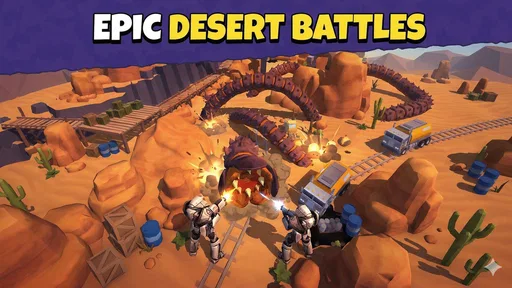
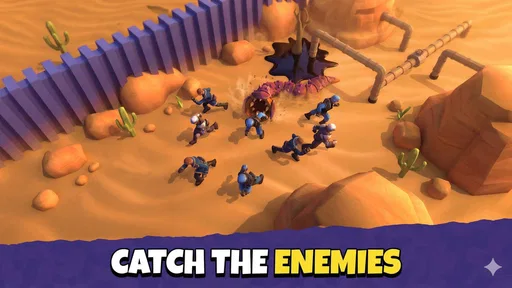
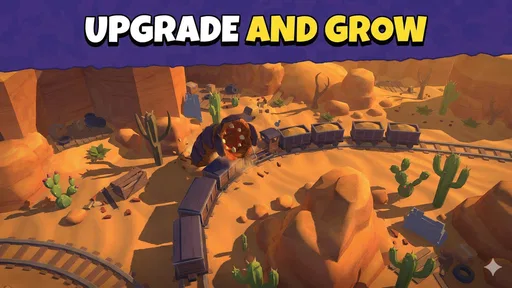
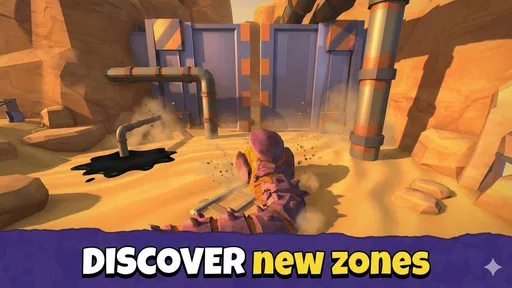

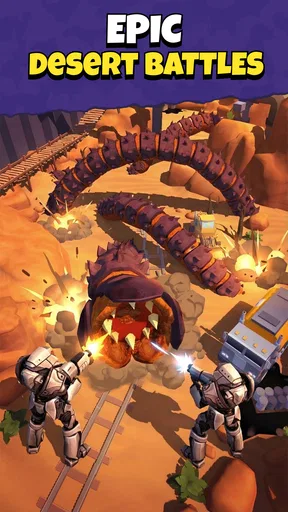

Our Review of Desert Worm Idle RPG
 Analysis by Appyee
I went into Desert Worm Idle RPG expecting a simple arcade time-killer, but its appeal is more specific than that. It combines the quick movement and immediate danger of an arcade game with the gradual growth loop of an idle RPG. I guide a worm through desert spaces, deal with enemies, improve its capabilities, and keep exploring rather than simply repeating one short challenge. That mixture makes it easy to understand, yet it also means the game works best when I accept a slower rhythm between bursts of action.
Developed by MULTICAST GAMES, this free arcade game is aimed at Teen players and is available with optional in-app purchases ranging from $1.99 to $99.99 per item. It has reached over 100K installs and holds a 4.4 average from around 3.3K ratings, which suggests that the central idea has found an audience. I would not treat those figures as a guarantee that everyone will enjoy the progression, but they do indicate that this is more than an obscure experiment.
How the desert loop feels in everyday play
The first thing I noticed is how clearly the game divides my attention. During active moments, I need to watch movement, enemies, and the surrounding space. Between those moments, I am thinking about upgrades and whether the next improvement will make exploration safer or simply more convenient. That contrast is what gives the game its identity. It is not trying to be a full-scale role-playing adventure, and it is not as instantly disposable as a traditional arcade round.
For a short session, I can open it when I have a few spare minutes and focus on making one useful improvement. In a longer session, the same structure gives me a reason to continue: explore, encounter resistance, strengthen the worm, and test that progress against the next obstacle. The loop is straightforward enough for casual players, but the value comes from choosing when to push forward and when to invest in growth.
That decision is more important than it may appear. If I spend every available resource immediately, I may feel stronger for a moment without creating a meaningful advantage for the next stretch. If I hold everything back, the game can feel unnecessarily cautious. My practical advice is to treat upgrades as preparation rather than decoration. Before entering a section that has already caused trouble, I would rather improve the part of the build that directly helps survival or progress than make a minor purchase simply because it is available.
The idle element also changes how I judge the pace. I do not expect every minute to deliver a new discovery. Some of the satisfaction comes from returning to a stronger character and seeing that a previously awkward encounter is now manageable. Players who need constant novelty may find this repetitive, while players who enjoy gradual progress should understand the attraction quickly.
What speed feels like during active play
Desert Worm Idle RPG feels fastest when I am responding to enemies and navigating the immediate danger around the worm. Those moments provide the arcade energy promised by the category. The game asks me to stay engaged rather than merely tap through menus, so the sense of speed depends on how confidently I move and how well I read the space in front of me.
Progression naturally feels slower than the action. That is not necessarily a technical problem; it is part of the design balance between arcade movement and idle development. The important distinction is whether I am waiting because the game is building anticipation or because I have run out of meaningful decisions. In my experience, the strongest sessions are the ones where an upgrade changes how I approach the next attempt instead of only increasing a number in the background.
This is also why I would not compare it directly with a pure reflex arcade game. A conventional arcade alternative may give me more immediate intensity and a clearer score-chasing loop. Here, the reward is spread across several visits. I get a more forgiving reason to return, but I give up some of the clean, instant competition that makes classic arcade games satisfying.
Where heavier play can expose friction
The busiest moments are likely to be the ones where active movement, enemies, exploration, and upgrade decisions overlap. Those are the situations in which I care most about responsiveness because hesitation can be caused either by my own mistake or by the device struggling to keep up. I found it useful to avoid making upgrade decisions in the middle of a tense encounter. Handling the progression choices before moving into danger keeps the action easier to read and reduces unnecessary interruptions.
Longer sessions also put more pressure on the overall experience than a quick check-in. The game’s free-to-play structure gives me an easy starting point, but optional purchases can become more noticeable when I am trying to accelerate progress. The listed purchase range stretches from small additions to much larger individual items, so I would recommend deciding on a personal spending limit before becoming invested in the upgrade loop. The game is more comfortable for me when purchases remain optional rather than becoming part of the expected routine.
A useful approach is to use short sessions for testing decisions and longer sessions only when I have a clear goal. For example, I might return to improve the worm before attempting a difficult area, then stop after confirming whether the change helped. That is more efficient than continuing indefinitely while making upgrades without knowing what solved the problem. It also makes the idle side feel purposeful instead of passive.
Another practical trade-off is attention. Idle RPGs can encourage checking in repeatedly, but the arcade side rewards being present. If I open the game while distracted, I may miss the moment when an enemy changes the situation or when exploration becomes risky. It is therefore better suited to a player who enjoys alternating between relaxed progression and focused bursts, not someone looking for a completely hands-off experience.
Reliability and the confidence to keep progressing
My standard for reliability here is not only whether the game opens. I also want the progression loop to feel dependable: active play should connect sensibly with upgrades, and returning to the game should feel like a continuation rather than a confusing reset. Desert Worm Idle RPG presents itself as a compact experience, so I expect its appeal to come from consistency rather than a huge amount of content competing for attention.
The current version is 0.7.2, which is worth keeping in mind when setting expectations. A version number like this makes me approach the game as an experience that may still be developing rather than as a completely settled arcade package. That does not make it unplayable, but it does affect how much patience I bring to rough edges, balance changes, or parts that feel less polished than the core idea.
For a reliable routine, I would make sure that my device has enough breathing room before starting a longer session and avoid treating an active encounter as a good time to switch rapidly between apps. Those are sensible habits for any mobile game, but they matter more when the game combines real-time movement with persistent progression. A brief session is a better test than assuming that a smooth opening automatically represents every later situation.
I also recommend judging the game by its repeatability rather than by the first few minutes alone. The opening can explain the basic appeal, but the real question is whether upgrading the worm changes my decisions. If I continue to face the same situation in exactly the same way, the idle layer may feel shallow to me. If improvements let me explore with more confidence or approach enemies differently, the return loop becomes much stronger.
Device expectations and practical limits
The minimum operating-system requirement is Android 7.1, so the game is not restricted to only the newest Android phones. That broad compatibility is useful for players who keep an older device as a secondary phone or who do not upgrade frequently. Still, operating-system compatibility alone does not tell me how comfortable every device will feel during heavy play. Screen response, available memory, battery condition, and general device health can all affect a game that mixes animation, enemies, and persistent systems.
I would begin on an older phone with a short trial rather than committing to a long session immediately. Watch for delayed input, unusual heat, or a noticeable drop in smoothness when several elements are active. If the game remains comfortable during those moments, it is probably a reasonable fit for that device. If it struggles only during busy encounters, I would be cautious, because those are exactly the portions where control matters most.
Players with limited storage or battery capacity should also think about how they use the game. The title is free to download, but the download price is not the only practical cost of a mobile game. Repeated check-ins, active exploration, and longer upgrade sessions can make it a less suitable choice for someone who needs extremely light, low-attention entertainment. In that situation, a simpler arcade game with shorter rounds may be a better match.
On a newer or more capable phone, the game’s modest presentation can be an advantage because it keeps the focus on movement and progression rather than overwhelming the screen. I would not choose it for visual spectacle. I would choose it when I want a focused desert-themed loop that can move between active play and incremental improvement without asking me to learn a large universe of systems.
Who will enjoy it, and who should pass
I think the best audience is someone who likes arcade action but wants a reason to return after a failed attempt. The worm, enemies, exploration, and upgrade structure create a useful middle ground between a reflex game and a conventional idle title. It suits players who enjoy seeing a character become more capable over time, especially when that improvement helps them handle a previously uncomfortable section.
It is also a reasonable choice for someone who prefers free games and is willing to ignore optional purchases. The presence of in-app items means I would not recommend it blindly to a player who dislikes any form of spending pressure. The purchase range is wide enough that budget-conscious users should decide in advance whether they will play entirely without buying or allow only occasional small purchases.
I would skip it if my priority were a deep story, a large role-playing world, or highly competitive arcade scoring. The game’s strength is its compact loop, not narrative scale. I would also choose a different option if I wanted a completely passive idle experience, because the active worm-and-enemy encounters are central to the appeal. Conversely, someone seeking nonstop action may find the upgrade pacing too measured.
Compared with a classic arcade alternative, this game offers more persistence and less emphasis on a single perfect run. Compared with a standard idle RPG, it asks for more attention and gives movement a larger role. That comparison explains both its charm and its limitation: it occupies an in-between space, and players who strongly prefer one side may find the compromise less satisfying.
Small habits that make the loop better
My first useful habit is to separate scouting from spending. I prefer to explore enough to understand what is stopping progress before committing resources. That prevents me from buying an upgrade merely because it is the next visible option. In a game built around gradual improvement, identifying the actual bottleneck makes each investment feel more meaningful.
My second habit is to use difficult encounters as tests rather than as invitations to repeat the same attempt endlessly. If the worm fails in a similar way several times, I take that as a sign to change the upgrade plan or slow down my approach. Repeating without learning is where the arcade side can become frustrating. A deliberate pause turns failure into information.
My third tip is to keep the game’s two rhythms separate in my mind. I do not expect idle progress to replace active skill, and I do not expect active play to deliver instant RPG-style growth. When I let each part do its own job, the design feels more coherent. The idle layer gives me a reason to return, while the arcade layer gives those returns something to do.
Finally, I would test the game at the same time of day and under the same device conditions in which I expect to use it. A quick lunchtime session can feel very different from a long evening session on a warm phone. That simple test helps answer the practical question that store descriptions rarely settle: whether the game fits my actual routine rather than merely sounding appealing in theory.
My performance verdict
Desert Worm Idle RPG is a focused hybrid with a clear personality. I like the way it turns a worm’s movement through a hostile desert into a progression loop instead of reducing the experience to one-off arcade attempts. The action gives the upgrades a purpose, while the idle structure makes failure less final and encourages me to come back later.
Its limitations are equally clear. The pace will not satisfy everyone, optional purchases require personal discipline, and the early version status makes me approach the game with reasonable expectations rather than demanding the finish of a long-established release. Device suitability should be judged during busy active moments, not only while browsing the quieter parts of the game.
For me, the strongest use case is a player who wants short bursts of arcade control followed by steady character growth. I would recommend trying it free before spending anything, especially if I am unsure whether the measured progression suits me. If that combination of exploration, enemies, and upgrades feels rewarding after several sessions, the game has enough of a distinct rhythm to earn a place in a mobile rotation.
Overall, I see it as a worthwhile pick for fans of idle arcade RPG games who want more involvement than a background progress bar can provide. It is not the right choice for every arcade fan, but its unusual balance is exactly why I would suggest it to a friend who enjoys experimenting with smaller mobile games. The best reason to install it is not the promise of endless spectacle; it is the chance to find out whether this particular blend of active movement and patient growth matches the way you like to play.
Verdict
Strengths of Desert Worm Idle RPG
- Simple idle progression makes it easy to play in short sessions.
- Distinct desert setting gives the game a memorable visual identity.
- Automatic battles reduce the need for constant tapping or micromanagement.
- Upgrade systems provide clear long-term goals for returning players.
- Runs smoothly on most modern phones with modest hardware requirements.
Limitations of Desert Worm Idle RPG
- Progress can feel repetitive once the early novelty wears off.
- Offline rewards may be limited compared with active play sessions.
- Later upgrades can require considerable grinding or waiting.
- The interface may feel crowded as more systems become available.
- Some players may find the combat too passive for an RPG experience.
Other Releases by MULTICAST GAMES
View All
Butcher Hero: Monster Idle RPG
Role Playing3.8
Similar Picks in This Category
View All
Subway Surfers
SYBO Games4.6

Stickman Party 234 MiniGames
PlayMax Game Studio4.6

Subway Princess Runner
Ivy4.4

Temple Run
Imangi Studios4.2

Zombie Tsunami
Mobigame SAS4.6

Stack Ball - Crash Platforms
CASUAL AZUR GAMES4.5
Frequently Asked Questions
What is Desert Worm Idle RPG about?
Desert Worm Idle RPG is an idle-style adventure game centered on exploring dangerous desert environments, battling enemies, and improving your character over time. The main progression continues through upgrades, equipment, abilities, and other rewards earned during play. Its automated mechanics make it suitable for short sessions, while active decisions are still important when choosing upgrades and preparing for tougher encounters.
Can Desert Worm Idle RPG be played offline?
The game may allow some progression or basic gameplay without a constant internet connection, but online access can still be required for certain features. Cloud saves, advertisements, events, purchases, updates, and account-related functions commonly depend on a connection. Before relying on offline play, it is best to test the game in airplane mode because requirements can vary between versions and devices.
Is Desert Worm Idle RPG free to download and play?
Desert Worm Idle RPG can generally be downloaded without an upfront purchase, but free access may include optional in-app purchases and advertising. These extras can provide currency, boosts, convenience items, or faster progression. You do not necessarily need to spend money to enjoy the core experience, although progress may feel slower if you choose not to watch ads or purchase optional upgrades.
Does Desert Worm Idle RPG contain ads or in-app purchases?
Players should expect that an idle RPG may use rewarded advertisements and optional purchases as part of its progression system. Ads can sometimes offer useful bonuses, while purchases may unlock currency, bundles, or time-saving improvements. Review the store listing and the game’s purchase settings before playing, and consider enabling parental controls if children will have access to the device.
What devices are compatible with Desert Worm Idle RPG?
Compatibility depends on the operating system, required version, available storage, and the developer’s current support list. Before downloading, check the official Google Play or App Store page for the latest Android and iOS requirements. A newer device is recommended for smoother performance, especially during busy battles, extended sessions, or when several visual effects appear on screen.
Play our best games!


